
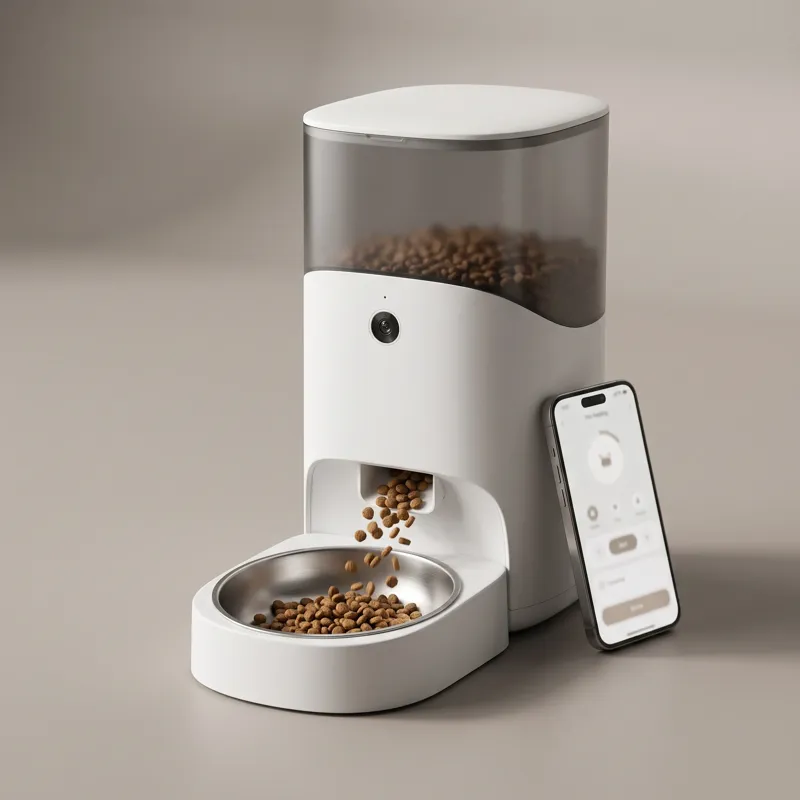

Automatic Cat Feeder
Automatic Cat Feeder Review: Types, Picks & Vet FAQ
SEO Title
Automatic Cat Feeder Review: Types, Picks & Vet FAQ
Meta Description
Automatic cat feeder review: Wi-Fi, camera, wet-food and budget types compared, vet-guided feeding advice, and which feeder fits your cat in 2026.
Introduction
If you’ve been woken at 4 a.m. by a cat who has decided that breakfast starts at first light, you already understand why automatic cat feeders exist. The modern versions are a long way from the gravity dispensers of decades past: they connect to Wi-Fi, schedule meals from an app, dispense portions down to a twelfth of a cup, watch your cat eat on a 1080p camera, and — in the newest twist — even refrigerate wet food or rehydrate freeze-dried meals into “soup.”
WIRED tested 12 of the most popular models for its 2026 guide, and reviewers across the category broadly agree on both the appeal and the fine print: these machines are excellent at portion control and routine, and they are never a replacement for you noticing whether your cat is actually eating. This review covers what automatic feeders do well, where they fail, which type fits which household, and the vet-reviewed answers to the questions people ask most.
Honesty note: this review is assembled from WIRED’s 2026 hands-on testing, vet-reviewed guidance from Webvet, manufacturer specifications, and our research file — not from hands-on testing of our own, which we don’t claim. Prices were checked on 2026-11-08 and change regularly; anything unverified is labeled “Not Verified.” Nothing here is veterinary advice for your individual cat.
Product Overview
An automatic cat feeder is any device that dispenses food without a human present. The category now splits into clear types:
- Gravity feeders — no power, no schedule; food falls as the bowl empties. Cheapest, least control.
- Timed feeders — a built-in clock dispenses set portions at set times; some program by knob, no app needed.
- Wi-Fi/app feeders — the mainstream of 2026: schedule meals, dispense on demand, and log feedings from your phone, with or without a camera.
- Camera + AI feeders — add a live video feed, two-way audio, and (on newer models) AI that recognizes individual cats. WIRED’s top AI-enabled pick, the Petkit YumShare Dual-Hopper 2 ($170 as listed in WIRED’s October 2026 guide), uses an algorithm to analyze remaining food and stop dispensing to prevent overfeeding — without requiring a subscription for pet recognition.
- Wet-food refrigerated feeders — the newest serious sub-category. WIRED’s top pick here, the Petlibro Polar Wet Food Feeder ($170), is essentially a mini-fridge that keeps food at 50°F or below and slides open sealed compartments at mealtimes, with a feeding log in its app.
- Microchip-selective feeders — bowls that open only for the cat with the matching microchip, the classic fix for multi-cat households where one cat steals everyone’s food.
Capacities run from 2 liters up to about 6 liters depending on the model — bigger hoppers mean fewer refills. Power designs mix cords, batteries, and rechargeable cells that let some feeders run cordless for weeks. A basic app feeder with a 2-liter hopper and a rechargeable battery is WIRED’s budget recommendation in the current field; premium models can add subscriptions on top (the Granary 2 Vision’s advanced AI features run $96–$160/year, per WIRED).
Key Features
- Scheduled, measured portions — app control typically covers multiple meals per day, with portion sizes measured down to 1/12 or even 1/24 of a cup
- On-demand feeding — dispense an extra snack remotely from your phone
- Feeding logs — many apps record when and how much was dispensed (individual-cat accuracy varies, see FAQ)
- Cameras — 1080p HD with night vision and two-way audio on camera models, so you can watch and talk to your cat while away
- AI multi-pet recognition — newer feeders identify individual cats and log who ate; on some models this needs a paid subscription ($96–$160/year on the Petlibro Granary 2 Vision, per WIRED), on others (Petkit) it doesn’t
- Bowl scales — premium models weigh remaining food (the Granary 2 Vision measures within a gram, per WIRED) and adjust to prevent overfeeding
- Backup power — most units accept AA/AAA/D batteries or include rechargeable backups so a power cut doesn’t skip a meal
- Stainless-steel bowls — removable for cleaning; a hygienic choice often recommended over plastic bowls
- Wi-Fi band awareness — some feeders work on 2.4 GHz only; others support both 2.4 and 5 GHz networks
- Wet-food cooling — refrigerated feeders hold 50°F or below and pause cooling 30 minutes before a scheduled meal
- Anti-jam and low-food sensors — on better models, to catch the classic “empty hopper” failure quietly
- Meal-call recordings — play a short recorded message at mealtime (sweet; also a training aid for food-obsessed cats)
Benefits
| Feature | What it means for you |
|---|---|
| Measured portions on a schedule | Portion creep stops — which is how most indoor cats gain weight; vets treat measured, timed meals as the core of weight management (Webvet’s vet-reviewed guidance) |
| Consistent mealtimes | Reduces 4 a.m. wake-ups, begging, and food-related anxiety; the feeder breaks the “you = food” association |
| Small, frequent meals | Many units split the daily ration into 4–6 mini-meals, closer to how cats naturally eat than one or two big bowls |
| App logs + cameras | Peace of mind while traveling; you can see that meals went out and who showed up to eat |
| Backup battery power | A short outage doesn’t mean a missed meal — schedules survive on most units |
| Microchip/multi-pet modes | Each cat eats its own diet at its own pace — the standard fix for food competition in multi-cat homes |
| Refrigerated wet-food options | Cats on wet-food diets can now eat on schedule with food kept fresh, not spoiling in a bowl |
Pros and Cons
| Pros | Cons |
|---|---|
| Ends the early-morning feeding wars without willpower battles | Every feeder is a single point of failure: jams, dead batteries, and dropped Wi-Fi all stop meals |
| Precise portion control — supports vet-directed weight plans | A quietly self-refilling bowl can hide a cat’s dropping appetite, which is often an early illness sign (vet-reviewed warning) |
| Scheduling flexibility: shift work, travel, late meetings | Multi-cat fairness is imperfect — open-bowl feeders invite the boldest cat to camp the machine |
| Cameras and logs add real peace of mind | Camera models carry app-quality complaints (laggy feeds, buggy apps) across even premium brands |
| Wet-food and freeze-dried innovations now exist (refrigerated units; rehydrating feeders) | Subscription creep: some advanced AI features cost $96–$160/year |
| Surprisingly affordable entry point for basic app models | Picky cats sometimes reject new equipment — and freeze-dried-rehydration experiments can flop (as WIRED’s tester found) |
| Battery backups make schedules robust | Standard hopper feeders are dry-food only; wet food needs refrigeration within hours |
Specifications
Class overview with examples from WIRED’s October 2026 tested field (prices as listed there; verify current before buying):
| Type | Example (WIRED-tested) | Capacity | App / Wi-Fi | Backup power | Warranty | Price as listed |
|---|---|---|---|---|---|---|
| AI camera, dual-hopper | Petkit YumShare Dual-Hopper 2 | 2 + 3 L (5 L total) | Yes / 2.4 + 5 GHz | Cord | 1-year limited | $170 |
| Wet-food refrigerated | Petlibro Polar Wet Food Feeder | 0.21 L (7.4 oz) | Yes / 2.4 GHz | 3× AAA | 2 years | $170 |
| Camera + bowl scale | Petlibro Granary 2 Vision | 5 L | Yes / 2.4 + 5 GHz; AI extras need $96–$160/yr plan | Rechargeable backup | 2 years | Not Verified |
| Freeze-dried rehydrating | Neakasa Riko | 3 L | Yes / 2.4 GHz | Battery backup | 1 year | Not Verified |
| Budget app feeder | Petlibro 2 L single (stainless bowl, rotor) | 2 L | Yes / 2.4 GHz | Rechargeable (~30 days claimed) | 2 years | Not Verified |
| Microchip-selective | SureFeed Microchip Feeder | Not Verified | No app (microchip) | — | Not Verified | $183.59 listed on Chewy via Webvet, 2026-11-08 |
| Basic app feeder (entry) | Petlibro Air (battery) | Not Verified | Yes | Battery | Not Verified | $49.99 listed on Chewy via Webvet, 2026-11-08 |
Note: the two Chewy prices above were displayed on Webvet’s vet-reviewed guide when we checked (2026-11-08); all other prices are from WIRED’s guide. Everything else moves with sales — verify current pricing.
Who Should Buy It?
- Households losing sleep to dawn-begging cats — the most common and most satisfying use case; multiple testers and vet guides agree the routine helps
- Cats on weight-management or vet-directed feeding plans — measured portions are the whole point; this is where feeders earn their reputation
- Shift workers and frequent travelers — consistent meals regardless of your schedule (with the alone-time caveats in the FAQ)
- Fast eaters and gorgers — splitting the daily ration into many small portions smooths out the gorge-vomit cycle WIRED cites as a common reason owners buy in
- Multi-cat homes needing separation — microchip feeders or dual-bowl models for cats on different diets
- Wet-food households — the refrigerated class (Petlibro Polar and peers) finally makes scheduled wet feeding plausible
- Tech-comfortable owners — if you already run a smart home, these slot right in; if app bugs would infuriate you, read the cons first
Who May Not Need It?
- Free-feeding households that are working fine — a healthy adult cat who self-regulates and never begs has nothing to gain from automation
- Cats whose appetite must be watched closely — vets specifically warn that a feeder can mask the appetite drop that signals illness; ask your vet before relying on one for an unwell, senior, or underweight cat
- Budget-first setups — a gravity feeder or a well-measured scoop routine costs far less; automated portioning is a convenience and consistency upgrade, not a necessity
- Anyone unwilling to clean and restock — hoppers need washing, kibble goes stale, and jams happen; unattended feeders accumulate problems
- Cats who fear the machine — noisy robots and unfamiliar sounds spook some cats; you’ll find out in the return window
- Multi-day absences — no feeder substitutes for a sitter; the alone-time cap is the same with or without one (see FAQ)
Alternatives
What to compare before you buy — by type:
Gravity feeder (no power). The $10-class starter: food flows down as the bowl empties. No portions, no schedule, no monitoring — but no failure points either. Fine for free-fed cats; wrong for weight management.
Basic timed feeder (no app). Sets meal times with a built-in clock and a knob. Rugged and cheap; you program it physically and give up remote feeding and logs.
Wi-Fi app feeder, no camera. The middle of the market and the sensible default for most buyers: schedules, on-demand snacks, and portion precision (down to 1/24 cup on some units) without camera cost. WIRED’s budget recommendation in this class was a 2 L Petlibro with a rechargeable battery.
Camera + AI feeder. Best for travelers and anxious owners — live video, two-way audio, and on the newest units, per-cat recognition and food-level analysis. Expect $170-class pricing for the good ones (Petkit YumShare Dual-Hopper 2 as tested), plus possible subscriptions on some brands.
Microchip-selective feeder. The multi-cat specialist: only the registered cat’s chip opens the bowl. The SureFeed was listed at $183.59 on Chewy when we checked; premium pricing for a premium fix to a specific problem.
Refrigerated wet-food feeder. The newest niche: a true mini-fridge (Petlibro Polar, $170 as listed) for cats on wet diets. If your cat eats exclusively wet food and you’re home twice a day anyway, the value is weaker; for daily travelers, it’s the only automated option that keeps wet food safe.
FAQ
Are automatic feeders good for cats?
For most healthy adult cats, yes — as a portion-control and routine tool, per Webvet’s vet-reviewed guidance. Veterinary nutrition bodies (AAHA, AAFP, as referenced there) center healthy feeding on measured portions, consistent mealtimes, and low-stress feeding patterns — exactly what a well-programmed feeder enforces, and cats are natural multiple-small-meals eaters (Cornell Feline Health Center guidance). The caveat is equally consistent: the machine feeds the cat but can’t watch the cat. Vets emphasize that you must still confirm daily that food is being eaten, because appetite loss is often the first sign of illness. If your cat has health issues, check with your vet first.
Are automatic feeders ever bad for cats?
They can be, in specific failure modes (per the same vet-reviewed guidance): multi-cat competition at open bowls (the boldest cat camps the machine), wet food spoiling in non-refrigerated units within hours, overreliance masking appetite changes, and mechanical failures — jams, dead batteries, dropped Wi-Fi. Used with daily human oversight, they’re widely considered a genuinely useful tool; used as a substitute for attention or a sitter, they cause exactly the problems vets warn about.
Can I use one feeder for two cats?
Physically yes — dual-hopper or dual-bowl models exist, and WIRED’s testing includes several (the Petkit YumShare Dual-Hopper 2 stores two food types; one budget dual-feeder puts bowls nearly a foot apart to reduce crowding). But be realistic about the logging: individual-cat feeding records are unreliable with open bowls. WIRED’s testers found the tracking feature “not as reliable” with two cats on a scale-based model, and AI recognition — the drawing card of newer feeders — is what actually distinguishes who’s eating. For cats on different diets (prescription food, weight plans), the honest answer is a microchip-selective feeder per cat.
Can an automatic feeder serve wet food?
Only with the right hardware. Standard hopper feeders are dry-kibble machines; wet food left at room temperature spoils within hours, and ice-pack compartment feeders only stretch that to about a day, not a weekend (per Webvet’s guidance). The modern solutions: refrigerated feeders that hold food at 50°F or below and open sealed compartments on schedule (the Petlibro Polar, WIRED’s top wet-food pick at $170 as listed), and one novel model that rehydrates freeze-dried food into wet meals at feeding time (Neakasa Riko — with the caveat that WIRED’s own cats rejected the rehydrated food, so try the concept before committing).
What happens if the power or Wi-Fi goes out?
Backup batteries are standard on quality units — WIRED’s tested field includes feeders running on AA, AAA, D batteries, and rechargeable packs (the budget Petlibro’s rechargeable battery lasts up to 30 days claimed, letting it run cordless). Power backups keep the dispensing schedule alive through outages; Wi-Fi is mainly needed for app control and camera access, so a lost connection typically costs you remote feeding and visibility, not dinner — schedule retention varies by model, so verify for the specific feeder.
How long can I leave my cat alone with an automatic feeder?
The feeder doesn’t extend the limit much on its own. Vet guidance caps alone time for a healthy adult cat at roughly 24–48 hours, and only with scheduled feedings, fresh water, and a check-in arranged — WIRED’s guide repeats the same 24-to-48-hour range. Beyond that: water runs out, litter boxes overflow, and a cat that stops eating can deteriorate without anyone noticing. Multi-day trips need a sitter; the feeder is an assistant, not a caretaker.
Final Verdict
An automatic cat feeder is one of the few pet-tech purchases that reliably delivers exactly what it promises: meals without you. For early-morning beggars, portion-control journeys, and schedule-chaotic households, a Wi-Fi feeder is a genuine quality-of-life upgrade — and the 2026 field is better than ever, with WIRED’s tested picks spanning a $170 AI dual-feeder (Petkit YumShare Dual-Hopper 2), a $170 wet-food mini-fridge (Petlibro Polar), and sensible budget app models. It is also not a magic wand: it can’t watch appetite, it can’t referee multiple cats on different diets (that’s microchip territory, ~$180), and every model in the category has app-quality warts worth reading up on before you buy. Used with daily human check-ins — and a vet consult if your cat has any health history — it’s one of the smartest little machines in the pet-tech aisle. Check current prices before checkout; the figures in this review are the ones we verified on 2026-11-08.
Relevant Internal Links
- Stainless cat water fountain review — anchor: “cat water fountain” — placement: “Who Should Buy It?” — feeding and hydration automation is the same research journey for the same buyer.
- Pet steam brush review — anchor: “pet steam brush” — placement: “Alternatives” — the grooming side of pet-tech for shedding households.
- Roomba 205 DustCompactor review — anchor: “dust-compactor robot vacuum” — placement: “Final Verdict” — pet-mess cleanup completes the automated-cat-home picture.
Affiliate Disclosure
This article may contain affiliate links. If you buy through them, we may earn a commission at no extra cost to you.
Sources
All sources checked or surfaced on 2026-11-08 (US market). Prices change — verify before publishing or buying.
- WIRED — “These 12 Automatic Cat Feeders Were the Best We Tested in 2026”: https://www.wired.com/gallery/best-automatic-cat-feeders/ (extracted 2026-11-08; updated October 2026: 12 feeders tested; Petkit YumShare Dual-Hopper 2 with camera at $170 — AI pet recognition without subscription, dual hopper, 2+3 L, 2.4/5 GHz; Petlibro Polar Wet Food Feeder at $170 — thermoelectric cooling at 50°F or below, three stainless bowls, 2-year warranty, 3× AAA backup, cooling pauses 30 minutes pre-meal; Petlibro Granary 2 Vision — 5 L, bowl scale to 1 gram, AI extras require $96–$160/year subscription; Neakasa Riko — freeze-dried rehydration, 3 L, 1-year warranty, tester’s cats rejected rehydrated food; budget Petlibro 2 L with rechargeable battery rated up to 30 days; budget dual feeder with bowls a foot apart and 4× AA backup; Pifi All-in-One and Pawsync scale-feeder multi-cat logging caveats; “How Long Can I Leave My Cat Alone?” — 24–48 hours guidance; gorging-vomiting cycle and vet links).
- Webvet — “Are Automatic Feeders Good for Cats? A Vet-Reviewed Answer”: https://www.webvet.com/are-automatic-feeders-good-for-cats (extracted 2026-11-08; vet-reviewed: portion control/routine/weight-management verdict; AAHA 2021 Nutrition and Weight Management Guidelines and AAFP patterns referenced; Cornell Feline Health Center feeding and obesity guidance referenced; risks — multi-cat competition, wet-food spoilage (ice packs ≈ 1 day), overreliance, jams/outages, overeating loopholes; appetite as illness signal; 24–48-hour alone-time cap; Chewy-listed prices shown on page on check date: SureFeed Microchip Feeder $183.59, Petlibro Air $49.99).
- Project research file: /home/ai-agent/livelihood-ops/research/us-products-20261108/MASTER-30-products-US-2026-11-08.md (Category 3, row 7) and category-3-seasonal-gifts-pets-fitness.md — trend evidence (WIRED gallery, Amazon Cat Feeding bestsellers, CNN Underscored), keyword set (all keywords above are verbatim autocomplete strings harvested 2026-11-08), FAQ sources (Rover/WebVet surfaced; Rover URL 404’d on re-check), competitor placement audit.
Verification note: no hands-on testing was performed or claimed — all testing references belong to WIRED’s published guide and Webvet’s vet-reviewed article. Prices captured 2026-11-08 from those pages and will move with promotions. Health-related content summarizes the cited vet-reviewed sources and is not individualized veterinary advice.
Internal links
- Target:
/cat-water-fountain/— anchor: “stainless cat water fountain review” — placement: “Who Should Buy It?” — why: same hydration/feeding automation journey; one purchase decision often triggers the other. - Target:
/pet-steam-brush/— anchor: “pet steam brush review” — placement: “Alternatives” — why: pet-tech accessory crossover for shedding households; keeps the visitor in the pet category. - Target:
/robot-vacuum-compactor/— anchor: “dust-compactor robot vacuum review” — placement: “Final Verdict” — why: closes the “automate pet care” loop with cleanup hardware; cross-sells Technology & Gadgets to pet owners.


Reviews
There are no reviews yet.